
Influencer Marketing ROI: How to Measure What Actually Matters

Influencer marketing is one of the most talked-about channels in marketing right now. It’s also one of the most misunderstood — especially when it comes to measuring whether it’s actually working.
The conversation usually goes one of two ways. Either a brand is thrilled because a post got thousands of likes, or they’re frustrated because they spent money on a campaign and “didn’t see results.” In both cases, the underlying issue is the same: they’re measuring the wrong things — or not measuring at all.
Influencer marketing ROI is measurable. It’s not as clean as a paid ad with a direct conversion pixel, but when you set up campaigns correctly and track the right metrics, you can build a clear picture of what’s working, what’s not, and how your influencer spend compares to your other marketing channels. This post breaks down exactly how to do that.
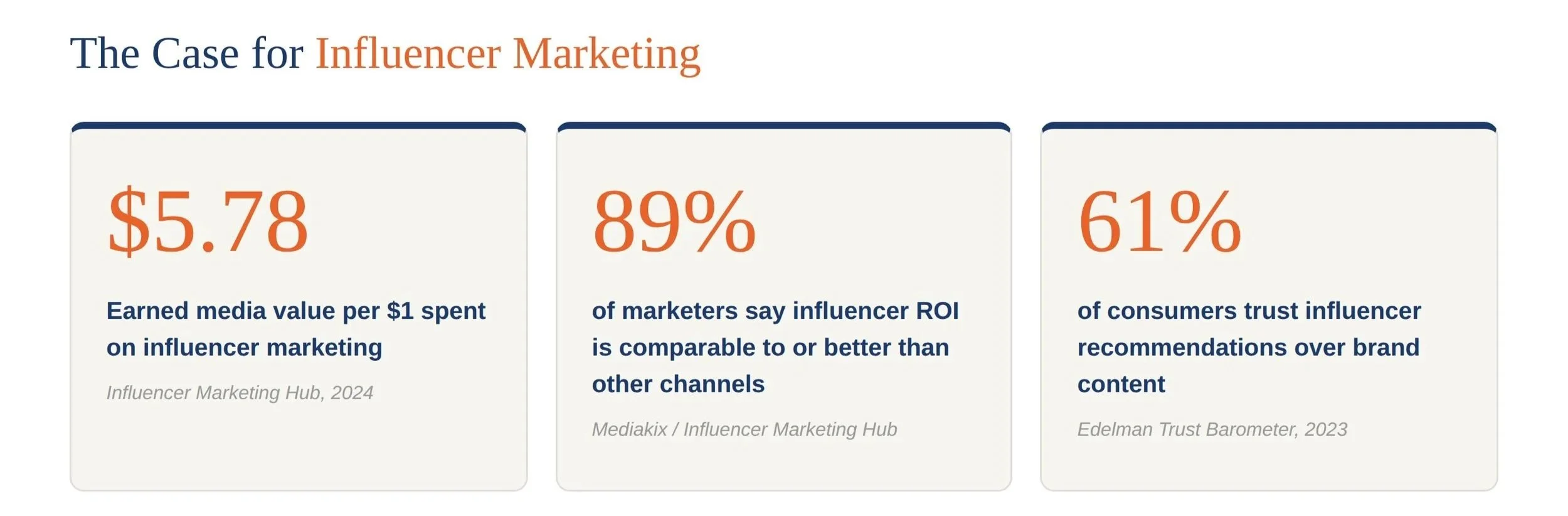
The short answer
Influencer marketing ROI is best measured across three layers: awareness (reach, impressions, engagement), intent (clicks, saves, profile visits), and conversion (promo code redemptions, UTM-tracked purchases, new followers). Most campaigns deliver value across all three — the key is knowing which layer matters most for each campaign before you launch.
Why measuring influencer ROI is harder than paid ads — and why that’s okay
If you’re used to running Facebook or Instagram ads, influencer marketing can feel frustratingly hard to measure. With paid ads, you get a direct line from spend to click to conversion. With influencer marketing, the path is often less linear.
Someone sees a TikTok from a creator they follow. They don’t click the link immediately — but three days later, they Google your brand name, land on your site, and buy. Your analytics attributes that sale to organic search, but the influencer campaign created the intent. That’s called dark social attribution, and it’s one of the reasons influencer ROI is consistently underreported.
The other reason: influencer marketing does work that paid advertising can’t easily replicate. It builds brand credibility through an audience that already trusts the voice introducing you. That trust puts your brand in front of people who weren’t looking for you yet — and that has real value even when it doesn’t show up cleanly in a last-click attribution report.
None of this means you can’t or shouldn’t measure influencer ROI. It means you need to measure it at the right level — which starts with being clear about what you’re trying to achieve before the campaign launches.
Set the goal before you set the budget
The single biggest mistake brands make with influencer marketing is launching a campaign without a clearly defined success metric. “We want more awareness” or “we want to go viral” are not measurable goals. Here’s how to think about it by campaign objective:
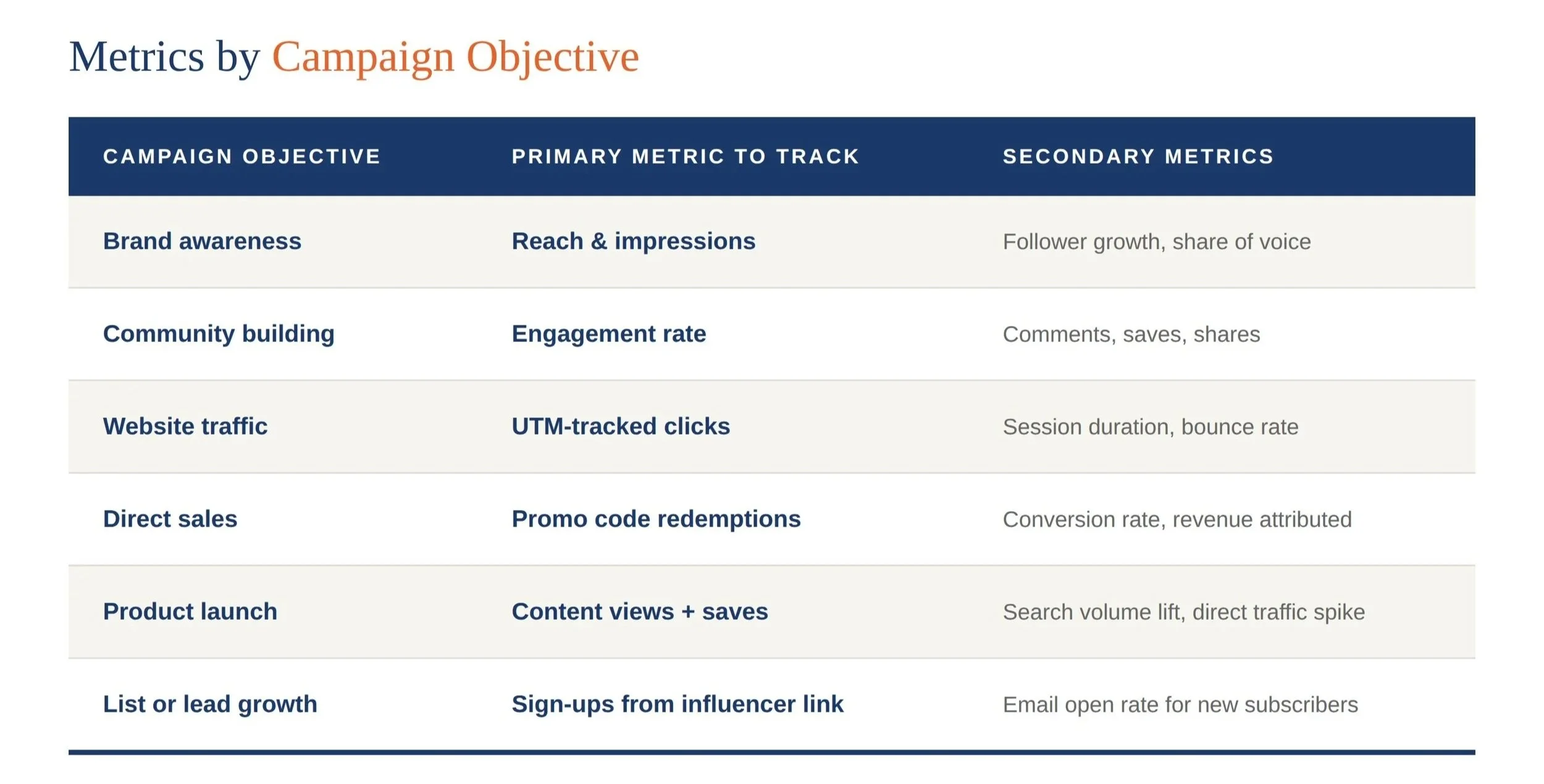
If your campaign doesn’t have a primary metric defined before launch, you’ll end up reporting on whatever happens to look good afterward. That’s not measurement — that’s confirmation bias.
The 10 influencer marketing metrics that actually matter
Here’s a full breakdown of the metrics worth tracking, how each is measured, and what each one actually tells you about campaign performance:
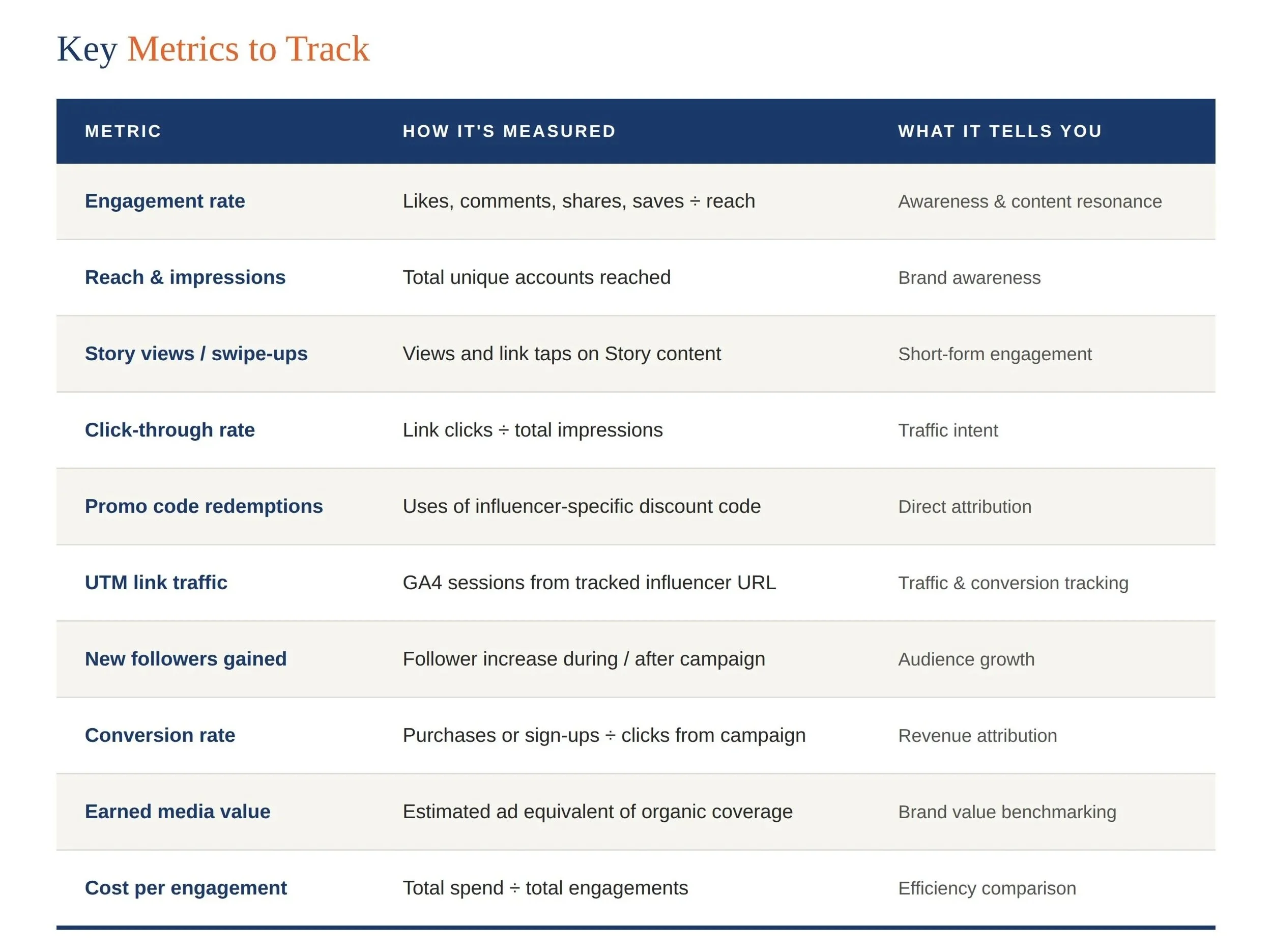
A few notes on this list:
Engagement rate is the most useful metric for evaluating creator fit before a campaign and campaign performance after. A creator with 50K followers and a 5% engagement rate will almost always outperform one with 500K followers and a 0.8% engagement rate in terms of actual impact on your brand.
Promo codes and UTM links are your direct attribution tools. If you’re running influencer campaigns without at least one of these in place, you’re flying without data. Every campaign should have a unique tracking URL and, where possible, a creator-specific discount code.
Earned media value is a useful benchmarking tool but shouldn’t be the centerpiece of your reporting. It tells you what equivalent paid reach would have cost — which can be useful context — but it doesn’t measure actual business impact.
Influencer marketing benchmarks by tier
Not all influencers are created equal — and your ROI expectations should vary depending on who you’re working with. Here’s how the numbers typically break down by influencer tier:
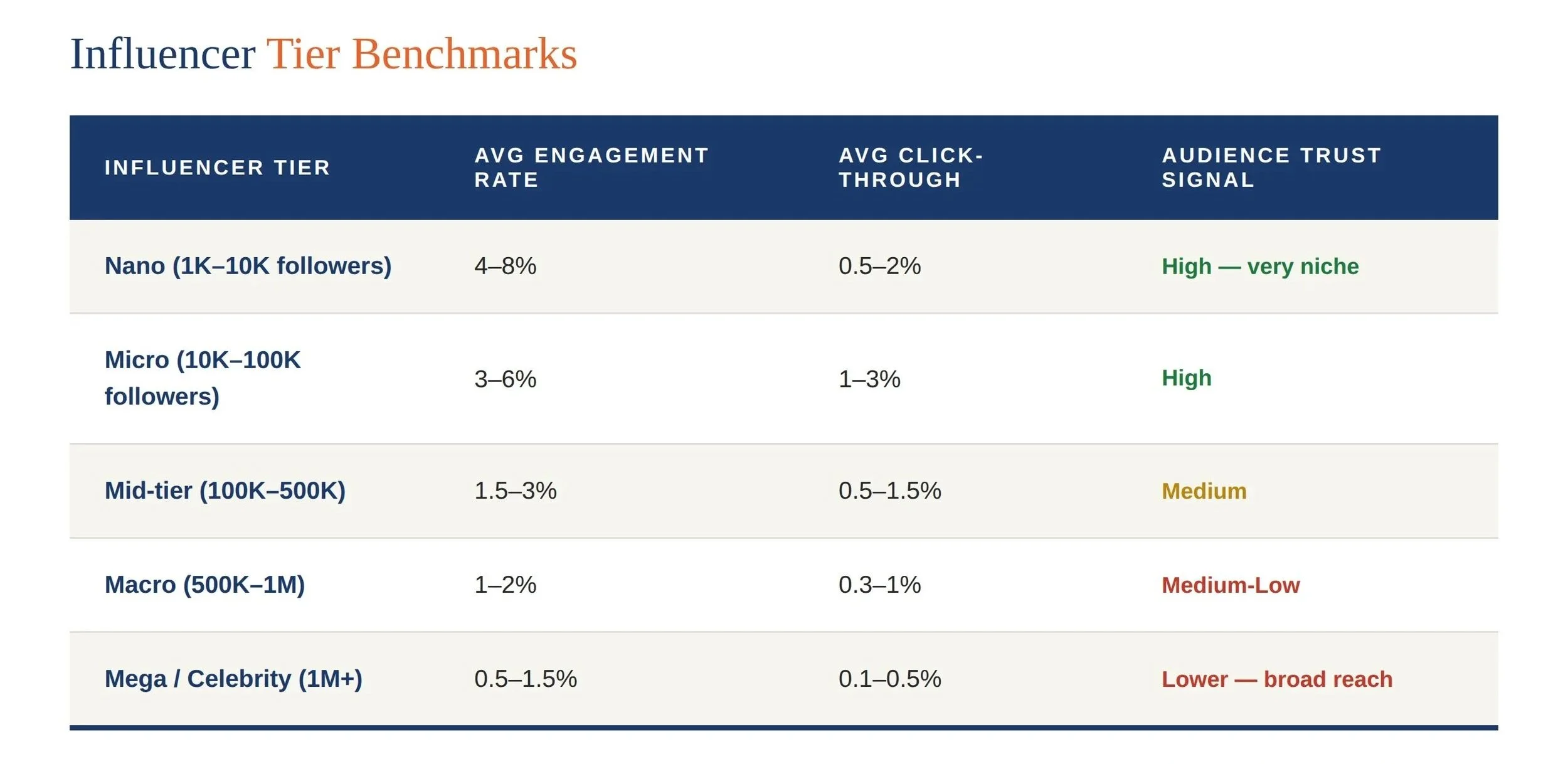
The pattern here is consistent and important: as follower count goes up, engagement rate goes down. Nano and micro influencers consistently deliver higher engagement rates than mega influencers, which is why they’ve become the go-to for small businesses doing influencer marketing for the first time.
This doesn’t mean large influencers have no value — they deliver reach and brand credibility at scale that smaller creators can’t match. But for a small business optimizing for ROI per dollar spent, a campaign with five micro influencers will typically outperform a single macro influencer campaign at the same total budget.
How to actually calculate influencer marketing ROI
Once your campaign is complete and you’ve gathered your data, here’s the framework for calculating ROI:
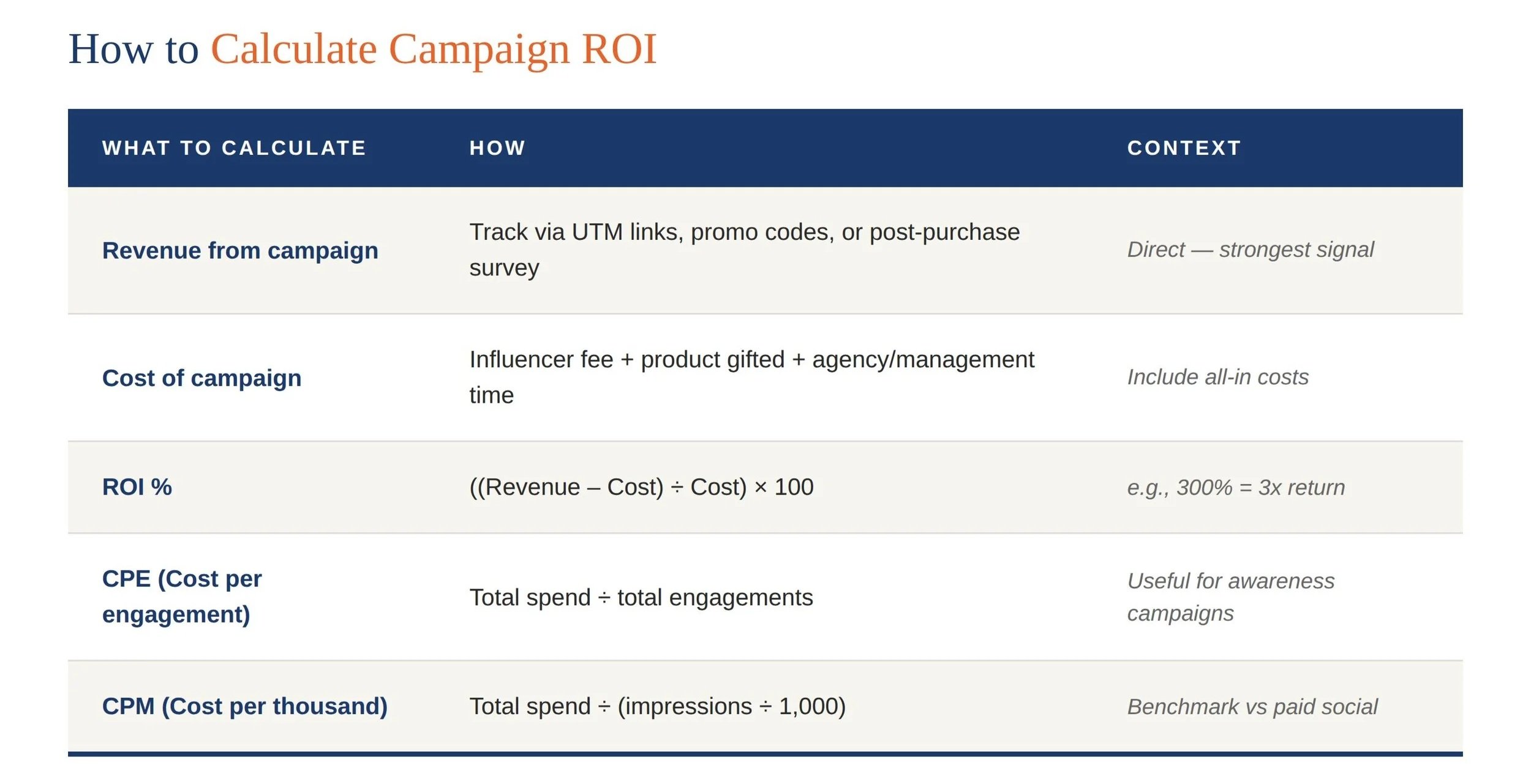
Worked example:
You run a campaign with two micro influencers. Total cost: $1,800 (fees + product). You track 85 promo code redemptions at an average order value of $65. That’s $5,525 in directly attributed revenue.
ROI = ((5,525 − 1,800) ÷ 1,800) × 100 = 207%
That’s a 3x return on a campaign that also generated brand content you can repurpose, new followers who didn’t exist before, and brand impressions that aren’t captured in that number at all. Most paid social campaigns at the same budget would struggle to match that across all three dimensions.
Handling attribution: the honest truth
Even with promo codes and UTM links in place, influencer campaigns will generate revenue and awareness that you can’t directly attribute. Here’s how to account for it without overstating the numbers:
• Monitor direct traffic and branded search volume during and after your campaign. A spike in people searching for your brand name is a clear signal that influencer awareness is translating into intent.
• Use post-purchase surveys. A simple “how did you hear about us?” question at checkout catches the dark social attribution that analytics misses. It’s low-tech but consistently reliable.
• Track new follower growth during the campaign window. New followers who came from an influencer’s audience are warm leads you can now nurture through your organic social and email program.
• Compare your campaign period to the equivalent period in the prior month or year. If overall revenue is up, website traffic is up, and engagement is up during an influencer campaign, that context matters even if you can’t attribute every dollar.
The goal isn’t perfect attribution — it’s honest attribution. Report what you can track directly, acknowledge what you can’t, and build the case for influencer marketing’s value across both. If you’re working with a TikTok influencer marketing agency or managing campaigns through a partner, this is exactly the kind of reporting framework they should be building into every engagement.
Red flags that signal poor influencer ROI before you launch
Not all influencer opportunities are worth taking. Here are the warning signs that a creator or campaign is unlikely to deliver strong ROI:
• High follower count, suspiciously low engagement — engagement rate below 1% on Instagram or below 2% on TikTok for an account under 500K followers warrants scrutiny. Check for purchased followers using tools like HypeAuditor or Modash.
• Audience demographics don’t match your customer profile — a creator with 80% of their audience outside your target market or outside your service geography isn’t a fit, regardless of their follower count.
• No content alignment — a creator whose feed has nothing to do with your product or service category will struggle to make the endorsement feel authentic. Authenticity is what makes influencer marketing work.
• No willingness to share analytics — any serious creator will share their audience demographics and recent post performance before a paid partnership. If they won’t, walk away.
• Overpromising on deliverables — guaranteed follower growth or guaranteed sales figures are red flags. What you can guarantee is execution. What you can’t guarantee is the outcome.
Influencer marketing ROI improves when it’s connected to your broader strategy

One of the most consistent things we see at Cucamonga Media: brands that treat influencer marketing as a standalone tactic get standalone results. Brands that connect it to their organic social media management, their email program, and their overall content strategy see compounding returns.
Here’s what that looks like in practice:
• The creator’s content gets repurposed as UGC across your own channels, extending the campaign’s lifespan well beyond the original post window.
• New followers from the campaign get nurtured through your organic social content rather than going cold after the initial post.
• The campaign timing is coordinated with an email sent to your existing list, amplifying the announcement and giving your most engaged customers early access.
• The influencer’s audience data informs your paid targeting, so your ad spend is directed at people who look like the creator’s most engaged followers.
When influencer marketing is one piece of a connected strategy rather than a siloed spend, the total ROI across all channels improves — and the individual campaign’s contribution is easier to see and justify.
Need help building an influencer strategy that’s actually measurable?
At Cucamonga Media, we manage influencer marketing for small businesses as part of a connected omnichannel strategy — meaning every campaign we run is built to track, report, and integrate with the rest of your marketing. If you’re not sure where to start, or you’ve run influencer campaigns before without clear results, that’s exactly the conversation we’re built for.
Frequently asked questions
What is a good ROI for influencer marketing?
Industry benchmarks typically cite $5–6 in earned media value for every $1 spent on influencer marketing, though direct revenue ROI varies significantly by industry, campaign type, and influencer tier. For product-based businesses with direct attribution tracking in place (promo codes + UTM links), a 2x–4x return on campaign spend is a reasonable benchmark for a well-executed micro influencer campaign. Awareness-focused campaigns are harder to measure in revenue terms but consistently show impact in brand search volume, direct traffic, and follower growth.
How do I track influencer marketing ROI without a large budget?
You don’t need expensive analytics tools to track influencer ROI. The most accessible approach: give each creator a unique discount code (free to set up in most ecommerce platforms) and a UTM-tagged link (free via Google’s Campaign URL Builder). Track redemptions and click-through in your existing analytics. Add a post-purchase “how did you hear about us?” question at checkout to capture dark social attribution. And monitor your follower growth and branded search volume during and after the campaign. That’s a complete picture with zero added tool cost.
Is micro influencer marketing better ROI than macro influencer marketing for small businesses?
For most small businesses, yes. Micro influencers (10K–100K followers) deliver higher engagement rates, stronger audience trust, and more targeted reach than macro influencers at a fraction of the cost. A campaign with multiple micro influencers in your specific niche will typically outperform a single macro influencer campaign at the same total budget — both in engagement and in direct attribution metrics.
How long does it take to see ROI from influencer marketing?
Direct attribution (promo code redemptions, UTM-tracked clicks) shows up within days of a campaign going live. Awareness and brand-building effects — increased branded search, organic traffic lift, follower growth — typically build over 2–4 weeks after a campaign. Some of the most valuable effects, like a creator’s audience becoming repeat customers over time, show up in your retention data months later. Influencer marketing is both an immediate and a compounding channel depending on what you measure.
What is earned media value in influencer marketing?
Earned media value (EMV) is the estimated cost of what influencer-generated content and coverage would have cost if you had paid for the equivalent reach through traditional advertising. It’s calculated by applying a CPM (cost per thousand impressions) rate to the organic reach generated by the campaign. EMV is useful for benchmarking and reporting but should be treated as context rather than a primary ROI metric — it measures the value of attention, not the value of action.
Should I use influencer marketing or paid social advertising?
The most effective approach for most small businesses is both — used strategically rather than in competition with each other. Influencer marketing builds credibility and reaches new audiences through trusted voices. Paid social advertising amplifies what’s already working, retargets warm audiences, and drives direct conversion. When influencer content is repurposed as paid social creative, performance typically improves significantly because the content already has proven organic engagement. If budget is limited, start with influencer marketing to generate authentic content and brand awareness, then layer in paid amplification once you have content that’s performing.
How do I find the right influencers for my brand?
Start with engagement rate, not follower count. Look for creators whose audience demographics match your target customer — age, location, interests, and intent signals. Review their recent content for authentic alignment with your product or service category: forced endorsements are obvious and perform poorly. Request their media kit and audience analytics before committing to any paid partnership. For small businesses, starting with nano and micro influencers in your specific niche almost always delivers better results than going straight to larger accounts.
Ready to run influencer campaigns that you can actually measure?
Cucamonga Media is a TikTok influencer marketing agency as well as other social channels like Instagram, LinkedIn, Pinterest and more. We handle creator sourcing, vetting, campaign management, and reporting — built into a broader omnichannel strategy so every campaign connects to the rest of your marketing. Get in touch to talk through what an influencer program could look like for your business.