The Reason Your Content Calendar Is Always Behind — And How to Get Ahead of It
Here's a question worth sitting with: how many pieces of content does your business actually need in a month?
Most brands dramatically underestimate the answer. One platform alone, say Instagram, benefits from feed posts, Reels, Stories, and Highlights. Add TikTok, LinkedIn, email campaigns, paid ads, your website, Google Business Profile, Yelp, press inquiries, and print collateral and you are looking at hundreds of individual assets per quarter, minimum.
The brands that show up consistently, professionally, and without scrambling at the last minute? They're not producing content in real time. They're working from a library.
Here's how to build one.
Why Most Businesses Are Always Behind on Content
The problem isn't effort. Most business owners care about their brand and want to show up well. The problem is infrastructure.
Content gets produced reactively, when there is a campaign to run, a post that needs to go out today, or a publication asking for photos by Friday. The result is a constant scramble: repurposing the same four images from 2022, resizing a blurry Instagram photo for a print ad, or passing on a press opportunity because there is nothing publication-ready in the folder.
Brands posting consistently on social media see 67% higher lead generation than those posting sporadically (HubSpot State of Marketing, 2024). Consistency isn't just a best practice but a competitive advantage. Consistency requires a content library, not a last-minute scramble.
Bulk capturing content solves this at the root. Instead of producing assets one at a time as needs arise, you produce a full library in a single intentional session — then deploy strategically across every channel for weeks or months.
Every Place Your Brand Actually Needs Visual Content
Before planning a shoot, it helps to map the full scope of where visual content actually lives. Most businesses are thinking about social when they should be thinking about everything.
Your website. This is your portfolio, your storefront, your first impression on a potential client or customer who found you through Google at 11pm. High-quality, on-brand imagery here builds credibility instantly. Stock photography undermines it just as fast — people can identify stock photos in under a second and associate them with inauthenticity (Nielsen Norman Group UX Research). Real photos of your real product, team, and space convert at a higher rate than anything generic.
Google Business Profile. This one surprises people. Regularly uploading new photos to your Google Business Profile is one of the simplest local SEO actions available because it signals to Google that your business is active, which directly influences local pack rankings. Businesses with photos on their Google Business Profile receive 42% more requests for directions and 35% more website clicks than those without (Google Business Profile Research). A quarterly shoot keeps your GBP fresh without any additional effort after the assets are captured.
Yelp. Especially for service-based businesses, Yelp profiles with robust, professional photo sections rank higher and earn more trust. A visitor choosing between two comparable businesses will almost always choose the one that looks like it takes its brand seriously.
Press and publication assets. When a podcast, a magazine, or an industry publication reaches out to feature your brand, and at the right growth stage, they will, the window is short. Having a folder of high-resolution, publication-ready assets means saying yes is easy. Not having them means scrambling, or worse, passing on the opportunity entirely.
Print ads and sponsorships. Direct mail, event programs, sponsorship banners, trade show materials — print still performs for many industries, and it requires high-resolution imagery that was captured with print in mind. Cropping a 1080x1080 Instagram post for a full-page ad is not a plan.
Organic social media. Feed posts, Reels, Stories, TikToks, LinkedIn content — the volume requirement here is significant for brands posting consistently. Brands that post video content on social media grow revenue 49% faster than those that don't (Wordstream Video Marketing Statistics, 2024). A library of vertical video clips and branded images makes consistent posting operationally manageable rather than creatively exhausting.
Email marketing. Newsletters and automated email flows need visuals — banners, product shots, behind-the-scenes imagery, team photos. Subscribers notice when a brand uses stock photography in email. Real, on-brand imagery builds the connection that stock simply can't.
Paid ads. The best-performing ads use original, brand-specific creative — not stock. And because ad creative fatigues quickly (audiences stop responding after repeated exposure), brands running paid social need a constant rotation of fresh assets. Ad creative is responsible for up to 70% of campaign performance variance (Nielsen Ad Impact Study, 2023). A content library makes testing and rotating creative operationally sustainable.
Blog headers and website editorial imagery. Custom photography aligned to your brand aesthetic keeps readers engaged and reinforces visual consistency across the site. It also supports SEO — original images with descriptive alt text contribute to image search visibility in a way that stock photos can't.
Customer stories and social proof. Real customers using your product or service, captured authentically, build trust faster than any sales copy. A few lifestyle shots or short video testimonials become some of the highest-converting assets in the library.
Team and culture content. Headshots, group shots, behind-the-scenes moments — humanizing content that makes your brand feel approachable and real. Whether the team is two people or twenty, showing the humans behind the business matters.
What a 2-Hour Bulk Content Shoot Actually Produces
This is where the math becomes motivating.
A well-planned 2-hour shoot — with a clear shot list, prepared locations, and intentional direction — typically produces:
40+ high-quality branded images spanning product shots, team content, lifestyle imagery, and behind-the-scenes moments. Shot and edited for multiple formats: square, horizontal, vertical.
A library of vertical video clips optimized for Instagram Reels, TikTok, LinkedIn video, and Stories. Raw footage that can be edited into multiple individual pieces of content — meaning a single 10-minute filming session can yield 5–8 individual posts.
B-roll footage for use in video ads, website headers, email banners, and blog content.
Repurposable evergreen assets — content that doesn't have an expiration date and can be pulled into campaigns, ads, or posts as needed for months after the shoot.
Depending on your content output and the platforms you're active on, a single well-executed shoot can set a brand up for 4–8 weeks of social content, a complete email asset refresh, a paid ad creative rotation, and updated website imagery — all from one session.
The key word is planned. A shoot without a shot list is an expensive afternoon. A shoot built around a specific content strategy is an infrastructure investment.
How Often Should You Be Shooting? (The Honest Answer)
Here's the honest answer most agencies won't give you: the brands that are truly winning aren't shooting quarterly. They're shooting weekly.
Not a full production day every week. But a consistent, intentional content capture session — even an hour — that keeps the library stocked, the creative fresh, and the brand showing up like it means it.
Content is king. That phrase gets thrown around so much it's lost its weight but the data backs it up completely. Brands that publish content consistently generate 3x more leads than those that don't, at 62% less cost (DemandMetric Content Marketing Statistics). The algorithm rewards consistency. Audiences reward consistency. And the brands that treat content production as a weekly habit rather than a quarterly project have a compounding advantage that's very hard to close once it's established.
Think about it this way: a brand posting 5 times a week on TikTok and Instagram needs roughly 40 pieces of content per month, minimum. That's before email assets, paid ad creative, Stories, website updates, or anything else. One quarterly shoot — even a great one — covers two or three weeks and then the scramble starts again. One monthly shoot buys you more runway but still leaves gaps. Weekly content capture is the only cadence that actually keeps up with what modern multi-channel marketing demands.
Here's what a weekly content rhythm looks like in practice:
Weekly micro-shoots (1–2 hours). Not a full production day — a focused, planned session that captures this week's content needs. New product spotlight. Behind-the-scenes of the week. A team moment. Seasonal content. A quick talking-head video on a topic that's relevant right now. Small, consistent sessions compound into an enormous library over time — and they keep the content feeling current and alive rather than polished and dated.
Monthly full shoots (2–4 hours). A more comprehensive session that captures campaign assets, hero imagery, paid ad creative, and evergreen content without a shelf life. This is where the 40+ images and vertical video library gets built. Plan these around upcoming launches, seasonal campaigns, and anything with a longer production window.
Quarterly deep dives. Brand refresh assets, website photography, team content, and publication-ready imagery. The session that updates the foundational visual identity — not the one that keeps the content calendar fed week to week.
The combination of all three is what separates brands with a genuine content engine from brands that are always one step behind their own marketing plan.
The mindset shift that makes this work: stop thinking of content shoots as events and start thinking of them as operations. The same way a product brand restocks inventory before it runs out, a content-first brand restocks the library before the calendar runs dry. It's not glamorous. It's not complicated. It's a system — and systems beat inspiration every single time.
The brands that wait until they need content to create it will always be reactive. The brands that build content production into the weekly rhythm of the business will always have something worth posting, something worth sending, and something worth running as an ad. That gap compounds fast — and it shows.
How to Get the Most Out of a Content Shoot
Planning is the difference between a shoot that produces 40 usable assets and one that produces 12 mediocre ones.
Build a shot list before the camera comes out. Map the content you need by platform and format. Instagram feed posts need different framing than TikTok vertical video. LinkedIn headers need different dimensions than email banners. Know what you're capturing before you start capturing it — or work with a team that does this planning for you.
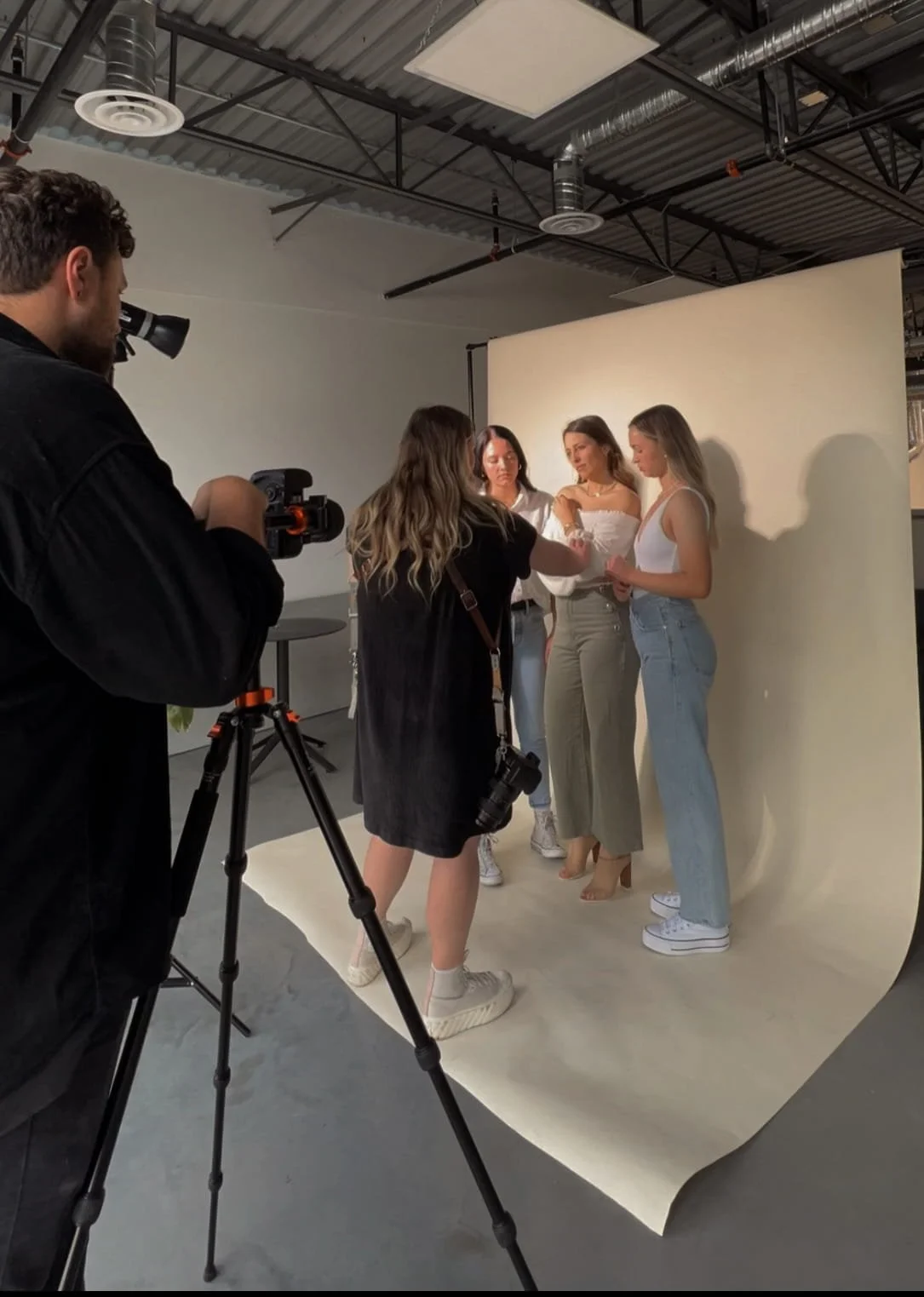
Prepare 2–3 outfit or setting variations. For personal brands and founder-led businesses, changing outfits gives the visual illusion of multiple sessions and dramatically extends the shelf life of the content. Different backgrounds and lighting setups do the same for product or location-based brands.
Create 2–3 distinct content zones. Varying the background, lighting, and setting within a single shoot makes the resulting content feel diverse rather than repetitive. A different corner of the space, a different surface, a different light source — small changes produce visually distinct assets.
Think about the platforms, not just the moments. Vertical video for social. Horizontal for website headers. Square for certain email formats. The best shoots capture everything in the right orientation from the start rather than trying to crop horizontal footage into a vertical format later.
Brief whoever is on camera. Content should feel natural, not forced — but natural takes preparation. Know the key messages for each piece of content, practice the delivery, and leave room for takes that are slightly off-script. Sometimes the unplanned moment is the one that performs best.
Content Is Strategy, Not Just Aesthetics
The most common misconception about content production is that it's a creative exercise. It's not — or at least, it's not only that.
Every piece of content in your library should connect to a specific marketing objective: building brand awareness, driving traffic, generating leads, converting buyers, or retaining existing customers. A photo is not just a photo. It's a top-of-funnel awareness asset, or a social proof piece, or a conversion-focused ad creative — depending on where and how it's deployed.

Brands that approach content with that level of intentionality get more mileage from every shoot. They're not just filling a content calendar. They're building a strategic asset library that serves the business across every channel, every campaign, and every growth stage.
That's the difference between content that looks good and content that works.
FAQ: Brand Content Creation and Bulk Shooting
What is bulk content creation? Bulk content creation — sometimes called batch shooting or content banking — is the practice of producing a large volume of branded visual assets in a single, planned session rather than creating content reactively as needs arise. The goal is to build a library of reusable images and videos that can be deployed across multiple channels over weeks or months.
How much content does a business actually need? More than most businesses expect. A brand active on Instagram, TikTok, LinkedIn, and email — running both organic and paid programs — can easily need 60–100 individual assets per month across all channels. Bulk shooting makes that volume operationally sustainable without constant production overhead.
What types of businesses benefit most from bulk content shoots? Any business that needs to maintain a consistent visual presence across multiple channels — product brands, service businesses, hospitality and experience businesses, personal brands, and agencies. The higher the content output requirement and the more channels a brand is active on, the greater the return on a well-planned content shoot.
How do I prepare for a bulk content shoot? Start with a shot list organized by platform and content type. Prepare outfit or setting variations to extend the visual diversity of the shoot. Identify 2–3 distinct shooting zones within the space. Brief anyone appearing on camera on key messages and tone. The more specific the preparation, the more usable the output.
How often should a brand be doing content shoots? Ideally, weekly — even if it's just a 1–2 hour micro-shoot to capture this week's content. The brands with the strongest content presence treat production as an ongoing operation, not an occasional event. A weekly micro-shoot, a monthly full shoot, and a quarterly deep dive is the cadence that keeps a multi-channel brand fully stocked without scrambling. Content is king — but only if you're producing it consistently enough for it to compound.
How does original photography help with SEO? Original images with descriptive, keyword-informed alt text contribute to image search visibility in a way that stock photos can't. Google Business Profile photos directly influence local pack rankings — businesses that upload new photos regularly signal active engagement to the algorithm. And original website photography reduces bounce rate by creating a more credible, trustworthy first impression, which is a positive signal for organic rankings.
What's the difference between UGC and brand content production? Brand content production is planned and directed by or for the brand — professional photography and video captured with specific brand guidelines and strategic objectives in mind. UGC (user-generated content) is content created by real customers or creators in an authentic, less polished style. Both have distinct roles: brand content builds credibility and visual consistency; UGC builds trust and social proof. The strongest content libraries include both.
TL;DR
Content is king, but only if you are producing it consistently enough for it to work. Your brand needs significantly more visual content than you think: across social, email, paid ads, your website, Google Business Profile, press, and print. The brands winning are not shooting quarterly and hoping for the best. They are shooting weekly, with micro-sessions that keep the library stocked, the creative fresh, and the brand showing up everywhere without scrambling.
A well-planned 2-hour monthly shoot produces 40 or more images and a full library of vertical video. Weekly micro-shoots keep the momentum going between them. Quarterly deep dives refresh the foundational brand assets. Together that cadence builds the kind of content engine that compounds over time.
The brands that treat content production as a weekly habit rather than an occasional event are the ones that always look ready. Because they are.
Cucamonga Media plans and produces brand content shoots for product and service brands that are serious about showing up consistently and professionally. Let's talk →