
Email Marketing vs SMS Marketing: Which Is Right for Your Business?
You've heard it a hundred times: the money is in the list. But which list are we actually talking about — email or SMS? And does it even matter?
If you're a small business owner trying to figure out where to invest your marketing dollars, the email vs SMS debate is a real one. Both channels have loyal advocates. Both have genuinely impressive stats. And both can be seriously misused if you don't understand what each one is actually built for.
At Cucamonga Media, we work with small businesses every day on exactly this question. As a Klaviyo email marketing agency for small businesses, we've helped brands at every stage — from building a list from scratch to overhauling automations that weren't converting — and the channel conversation comes up constantly. Here's our honest take.
Quick answer
Email is better for nurturing, educating, and building long-term relationships.
SMS is better for urgency, reminders, and time-sensitive communication.
For most small businesses, the highest-ROI move is building email first then adding SMS once the foundation is solid.
What is email marketing?
Email marketing is the practice of sending targeted messages — newsletters, promotional campaigns, automated sequences — to a list of people who have given you permission to contact them. It's one of the oldest digital marketing channels and, by most measures, still one of the most effective.
For small businesses, email marketing typically includes:
Welcome sequences that introduce new subscribers to your brand
Promotional campaigns tied to sales, launches, or seasonal events
Newsletters that build loyalty and keep your audience engaged between purchases
Automated flows — abandoned cart, post-purchase follow-up, win-back — that run without you lifting a finger
Platforms like Klaviyo, Mailchimp, and ActiveCampaign power most small business email programs. Our email marketing services are built around Klaviyo in particular — it's the platform we recommend most for ecommerce and product-based businesses because of its deep segmentation, revenue attribution, and automation capabilities that go well beyond what most basic email tools offer.
What is SMS marketing?
SMS marketing means sending text messages — usually short, direct, and action-oriented — to customers who have opted in to receive them. It's a relatively newer channel for marketing (compared to email) but one that's growing fast, particularly for businesses with high-repeat-purchase customers or time-sensitive offers.
Common uses for SMS marketing include:
Flash sale announcements and limited-time offers
Appointment reminders and booking confirmations
Order updates, shipping notifications, and delivery confirmations
Loyalty program updates and exclusive member offers
Re-engagement messages to lapsed customers
Platforms like Attentive, Postscript, and Klaviyo (which does both) are the most common SMS tools for small businesses. One important note: SMS marketing is more heavily regulated than email. The TCPA (Telephone Consumer Protection Act) governs text marketing in the US, and opt-in requirements are stricter. You can't just import a list and start texting — every subscriber must have explicitly consented to receive SMS from you.
Email vs SMS: side-by-side comparison
Here's how the two channels stack up on the metrics that matter most for small businesses:
According to Mailchimp's 2024 email marketing benchmarks, the average email open rate across all industries is 35–45%, with click-through rates averaging 2–5%. SMS open rates, by contrast, are consistently reported at 95–98% — with the majority of texts read within three minutes of receipt, per SimpleTexting's SMS marketing report.
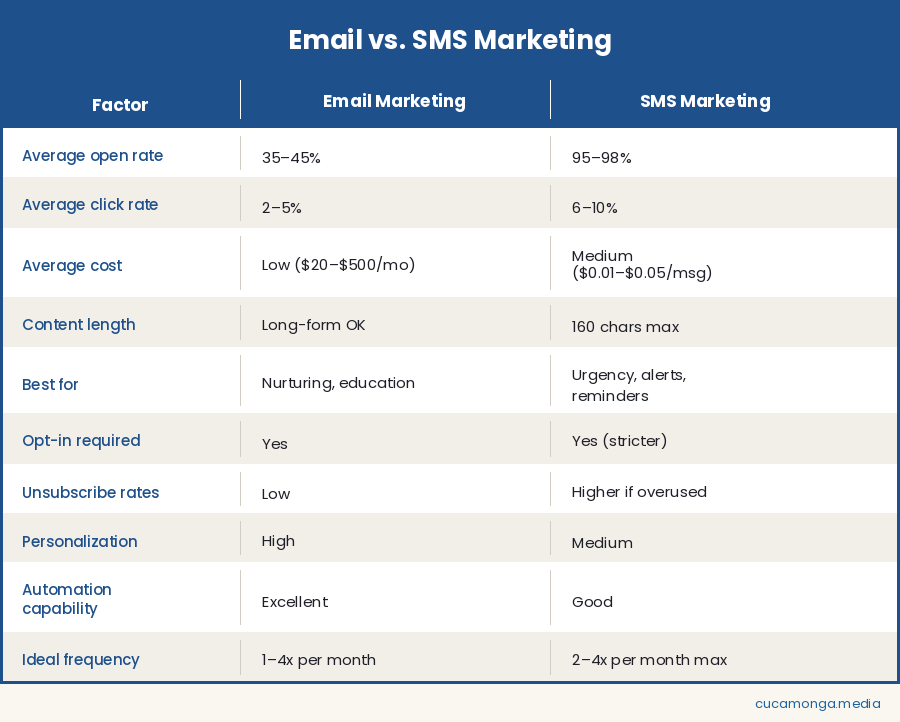
Source: Mailchimp Email Marketing Benchmarks 2024; SimpleTexting SMS Marketing Statistics 2024
A few things worth unpacking from this table:
SMS open rates look incredible at first glance — 95–98% sounds almost too good to be true. But those opens don't always translate to clicks or conversions the way email does. The brevity of SMS means you have very limited space to make your case, and the bar for an annoyed unsubscribe is much lower. High open rates are only valuable if the message is worth opening.
Email's average click rate of 2–5% sounds low until you compare it to most other marketing channels. A well-segmented email list with relevant content regularly outperforms paid social advertising on a cost-per-acquisition basis.
Email marketing: strengths and limitations
Where email wins
Depth and nuance — you have room to tell a story, explain a product, share a case study, or educate your audience in a way 160 characters simply can't match.
Automation at scale — sophisticated flows can segment your audience and deliver the right message at exactly the right stage of the customer journey, automatically.
Cost efficiency — even robust email programs are relatively inexpensive compared to paid channels, especially as your list grows.
Data richness — email platforms give you detailed analytics: open rates, click maps, revenue attribution, A/B test results, and deliverability monitoring.
Longevity — unlike a social post that disappears in an algorithm, an email sits in an inbox until it's read or deleted. Timing is less critical.
Where email has limitations
Inbox competition is real — the average professional receives over 100 emails per day, and standing out requires good subject lines, consistent branding, and genuine value.
Deliverability requires ongoing attention — poor list hygiene, high bounce rates, or spam complaints can land your emails in the junk folder where they'll never be seen.
Slower urgency — email isn't the right channel when you need someone to act in the next two hours.
SMS marketing: strengths and limitations
Where SMS wins
Immediacy — texts are typically read within three minutes of receipt, making SMS the best channel for anything time-sensitive.
Cut-through — even in a noisy digital environment, a text notification gets attention in a way an email notification rarely does.
Simplicity — the format forces you to be direct and clear, which is actually a feature when your message is straightforward.
High engagement for transactional messages — order confirmations, shipping updates, and appointment reminders perform exceptionally well over text.
Where SMS has limitations
Low tolerance for frequency — most consumers are willing to receive 2–4 texts per month from a brand. More than that and unsubscribe rates climb sharply
Limited creative space — you can't include an image, a long explanation, or multiple CTAs in a text without it feeling overwhelming or getting cut off
Stricter compliance requirements — the legal and technical requirements for SMS are more demanding than email, and violations can be expensive
Higher per-message cost — while email is essentially flat-rate, SMS costs scale with volume, which matters for businesses with large lists or high send frequency
When to use email vs SMS
Here's a practical guide to match the channel to the message:
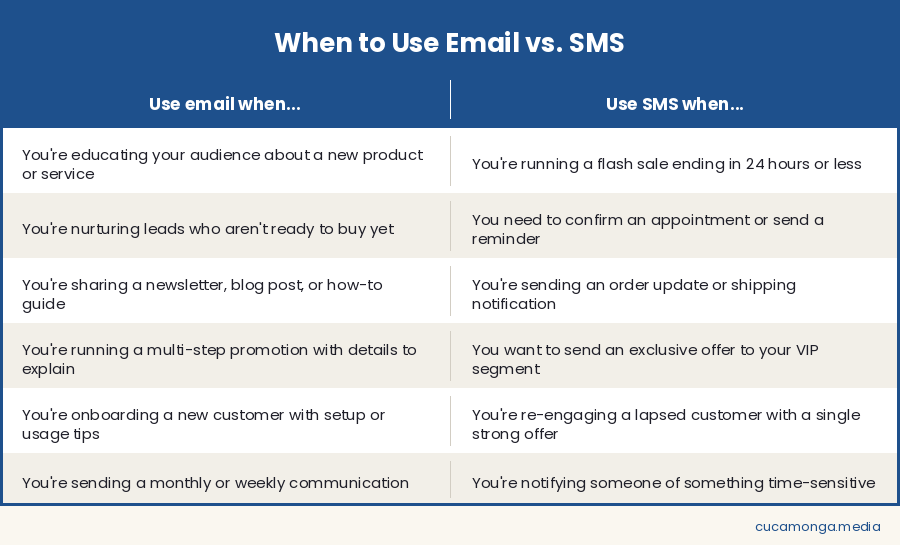
a guide on when to use email vs sms
When to use email and SMS together
The most effective approach for many small businesses isn't choosing one or the other — it's using them as a coordinated pair, each playing to its strengths.
Here's what that can look like in practice:
Launch sequence: Send an email before a sale with full details, context, and early access. Send a text the morning it goes live as a quick reminder with a direct link.
Abandoned cart: Use email automation for a two-step abandoned cart sequence (reminder + follow-up with an incentive). Use SMS for a single final nudge 24 hours before the incentive expires.
Post-purchase: Send email with full onboarding, instructions, and cross-sell recommendations. Send SMS for the shipping confirmation and delivery notification — people genuinely want those by text.
VIP program: Communicate most loyalty content through email. Reserve SMS for exclusive flash access that makes VIP members feel genuinely special.
81% of small businesses rely on email as their primary customer acquisition channel. Just 36% use SMS marketing — meaning there's significantly less competition for attention in your customers' text inbox, but email remains the more battle-tested foundation.
— Campaign Monitor Small Business Marketing Report
The key principle is intentionality. SMS should feel like a privilege, not a fallback. If someone gives you their phone number, they're offering a higher level of trust than an email subscriber. Treat it accordingly.
So where should you start?
If you're a small business and you haven't built a solid email program for your small business yet, start there before adding SMS.
Here's why:
Lower cost of entry — you don't pay per send the way you do with SMS
More forgiving learning curve — the consequences of a suboptimal email are lower than a poorly timed text blast
Richer tools for segmentation, automation, and analytics
The foundation most other channels (including SMS) are built on — a great customer journey lives in email
Once your email program is humming — meaning you have a clean list, solid automation flows, and consistent campaign performance — that's the right time to add SMS as a complementary channel for high-intent moments.
If you're already solid on email and looking to layer in SMS, start with transactional messages (order updates, appointment reminders) before moving to promotional texts. Build trust with the channel before you use it for selling.
Need help figuring out which channel to prioritize?
At Cucamonga Media, we help small businesses build email and SMS programs that work together as a coordinated strategy. As a fractional marketing agency, we act as your embedded marketing team — handling platform setup, automation builds, campaign management, and ongoing optimization without the overhead of a full-time hire. If you're not sure where to start, that's exactly the conversation we love having.
Frequently asked questions
Is email marketing or SMS marketing better for small businesses?
Email marketing is generally the better starting point for small businesses because of its lower cost, richer analytics, and higher automation capability. SMS is powerful for urgency and high-intent moments, but works best as a complement to a solid email program rather than a replacement for one.
What is the average ROI for email marketing vs SMS marketing?
Email marketing consistently delivers among the highest ROI of any marketing channel — commonly cited at $36–$42 for every $1 spent, though this varies widely by industry and list quality. SMS ROI figures are less standardized but tend to be strong for ecommerce businesses with high-repeat-purchase customers. Direct comparison is difficult because the two channels excel in different parts of the customer journey.
Can I use the same platform for both email and SMS marketing?
Yes — platforms like Klaviyo handle both email and SMS in a single interface, which makes it easier to coordinate messaging across channels, share audience data, and build cross-channel automations. This is generally the most efficient approach for small businesses that want to run both channels without managing two separate platforms and two separate contact lists.
How often should I send marketing emails vs text messages?
For most small businesses, 1–4 emails per month is a reasonable starting cadence — enough to stay top of mind without overwhelming your list. SMS should be used more sparingly: 2–4 texts per month is a common guideline, and promotional texts should feel exclusive and well-timed rather than routine.
Do I need a separate opt-in for SMS vs email?
Yes. Email and SMS opt-ins are separate under US law. Someone who subscribes to your email list has not consented to receive text messages from you. You need explicit, documented consent for SMS — typically via a checkbox or dedicated opt-in form where the subscriber acknowledges they're agreeing to receive texts. This is a hard legal requirement under the TCPA.
What is the best email marketing platform for small businesses?
Klaviyo is the top choice for ecommerce and product-based businesses because of its deep segmentation, robust automation flows, and direct integrations with platforms like Shopify. Mailchimp is a solid entry-level option for service-based businesses. ActiveCampaign works well for businesses with complex automations or longer sales cycles. The right choice depends on your business model, list size, and how sophisticated you want your program to be.
How do I grow my email list as a small business?
The most reliable list-building tactics for small businesses are: a compelling opt-in offer (discount, free resource, or exclusive content) on your website homepage and checkout flow; a pop-up or slide-in form triggered after 30–45 seconds of browsing; consistent promotion of your list on social media; and in-person collection at events, point of sale, or during service delivery. Quality matters more than size — a smaller, engaged list outperforms a large, cold one every time.
Ready to build an email program that actually works?
Cucamonga Media is a Klaviyo email marketing agency for small businesses. We handle strategy, automation, campaigns, and list growth — so your email list becomes one of your most reliable revenue channels rather than something that gets pushed to the bottom of your to-do list. Get in touch to talk through where you are and what we'd recommend.